Sunday, July 1, 2018

At a Crossroads


Welcome back to the next blog post of Thriving Not Just Surviving. 

This one is written by Maureen so it may take on a different tone of writing but I will try to do what I can to keep with Greg’s impeccable writing. 

Catching Up
Monday, June 25th around 10:25pm Greg had another seizure, despite the CPAP machine. We knew that the machine most likely wouldn’t completely eliminate the seizures, but we were hoping that it would help. Despite the seizure Monday, being on the CPAP machine for 10 days now, Greg has seen an improvement in quality of sleep.
This seizure makes episode number 4 and was much like the other ones with one main difference. I was told to take the CPAP machine off if he started to seize (it was more of a guess on their part, I think, as Greg is a special case). In doing this, Greg stopped breathing without the aid of the machine and his lips turned blue. As you can imagine, not only watching your husband have a seizure but now stop breathing and turn blue was a lot to handle. Thankfully, he started breathing on his own again and we waited out his post-seizure state until he was conscious again and I took him to the ER as we suspected he fractured his shoulder again. This was confirmed at the ER. He has an appointment with an orthopedic surgeon in St. Louis later this week to find next steps to care for that.
Instead of driving to STL right away, we stayed in KC for a few days (thank you so much to the friends who assisted in this!) We learned our neurologist was on vacation so we wouldn’t be able to get an appointment until the following week (this coming week). Wednesday night we did receive a phone call from our neurologist (a very kind man to take time of vacation) and we drove to STL Thursday for tests.
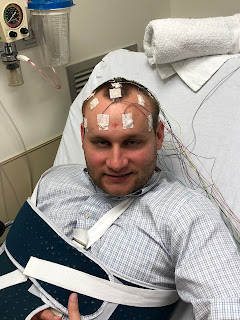
This test consisted of Greg being hooked up to an EEG for 24 hours to monitor the brain waves, and if he had a seizure to give them some information. This is an outpatient EEG you take it home, but you can’t shower for the duration and you look quite interesting, so going out in public isn’t very high on the list of things to do (pictures will accompany this post). After we arrived in town Thursday afternoon, Greg got this hooked up. This is lengthy process takes about an hour. Friday afternoon we went back to the hospital, got the wires removed and, on the drive back to his parents got a call that nothing had recorded for the last 24 hours and we had to come back Saturday morning to try it again. Not what you really want to hear when it’s 100 degrees out, with all of this equipment glued to your head and you can’t do anything or go anywhere for 24 hours. 

Where does that leave us?
Greg’s doctor bumped up his anti-seizure medicine to its maximum dose. There is always an adjustment period with the increase. So far, we are 6 days in to the adjustment and due to the high levels of medicine it has been difficult for Greg to fully adjust this time. He is taking it all in stride, I’m very proud of his perseverance and determination. We are hoping and praying that this week provides some clear paths for us. I don’t think anyone would be surprised that we are at a point where both Greg and I are both frustrated at the lack of “normalcy” in our lives. By the time we get back into a routine of being in KC together, him going into the office, PT, message and Chiropractic appointments scheduled, another seizure happens. When we meet with our neurologist this coming week we will be pushing for more aggressive measures to find some answers. One of these measures would include being admitted to the Epilepsy Monitoring Unit (EMU) at Barnes where Greg would be monitored 24 hours a day for up to 7 days. He would be removed from his medicine and seizures would be provoked to monitor the brain before, during and after the seizures to find answers and possible solutions. While this may sound very unpleasant, we are praying that this can become a reality very quickly. You know both Greg and I aren’t people to remain idle and we want to get to the bottom of this and find a more normal balance. Whether that is achieved by different medication, a combination of medications, or in rare instances, brain surgery to fix the problem.
We grateful for the continuous prayers and support you all provide. Please keep praying to Blessed Fr Solanus Casey for Greg’s complete healing of cancer and seizures.  

Here is the Solanus Casey prayer:
O God, I adore you. I give myself to You. May I be the person You want me to be, and may Your will be done in my life today. I thank You for the gifts you gave to Fr. Solanus. If it is Your will, bless us with the canonization of Fr Solanus, so that others may imitate and carry on Your love to all the poor and suffering in this world. As he joyfully accepted Your divine will, I ask You, according to Your will, to hear my prayer for Greg Fiudo, that he may be fully and completely healed of cancer and seizures through Jesus Christ our Lord.
Amen.


Sunday, June 24, 2018

Adjusting to CPAP


Welcome back to the next Thriving not Just Surviving blog post. I’m very pleased to report that I received my CPAP machine and returned to Kansas City last Thursday afternoon. I’ve spent the last few days settling in and adjusting to the CPAP machine at night. So far, it’s going well.

It’s a pretty slick process. The CPAP machine has a hard drive and can transmit data over a cellular network to an app on my phone, which allows me to see different types of advanced sleep statistics. It also transmits data to a sleep therapist who can use the data to make recommendations for adjusting the air pressure and other settings on the machine. My doctor can also see this data and provide recommendations as well.

I’ve now used the machine for three nights and I’ve experienced a significant improvement in my quality of sleep. As you might remember, during the sleep study I was experiencing approximately 36 sleep apnea events per hour. With the CPAP machine that number has dropped to 5-8 events per hour. Although not perfect, I am starting to feel the benefits of an improved quality of sleep.

For the past few months I would normally have to sleep 10-12 hours on both Friday and Saturday nights. Additionally, I would also need to take a 3-4 hour nap on Sunday in order to recover for the upcoming work week. Its still early on, but I don’t feel the need to have that type of sleep regimen now that I’m on CPAP.

Despite the good results, its still weird to be under the age of 30 and be needing a CPAP machine. Apparently sleep apnea can affect anyone at any age. However, similar to lung cancer, most people appear to be at a later stage in life. I laughed as I read through the testimonials of sleep apnea patients using CPAP. According to them, I should now have the energy and confidence to do water aerobics, model trains, and puzzles.

Its great to be back and I’m thankful that my health appears to be much more stable. To be completely honest, its been an overall rough start to 2018. The significant impact of the seizures on my body as well as the unpredictability of their occurrence has definitely taken a toll. I think the toughest part has not been the physical impact, but the mental and emotional impact of being away from home for extended periods of time.

We are nearing the halfway point of 2018 (approximately 26 weeks). To date, I’ve spent 9 weeks total in Kansas City since the start of the year. That’s a staggering amount of time to be away. I was actually hesitant to count up the weeks because I knew it was a lot, but I think it’s a great illustration of what some patients who have to seek medical care in another city are faced with on a daily basis.

Moving forward, we will be working to establish a relationship with a neurologist in Kansas City. This will hopefully create some long-term stability even if the seizures return. However, all my cancer care will continue to be at Siteman Cancer Center in St. Louis.

Maureen and I continue to be blessed with the prayers and support from all the communities in our lives. We cannot thank you all enough.

Sunday, June 17, 2018

Waiting For CPAP


Welcome back to the next Thriving not Just Surviving blog post. I decided to take a few weeks off from posting because there hasn’t been much to report. Its been a slow process waiting for the official results of the sleep study that was conducted at the end of May.

Fortunately, I received the results a few days ago and we will be moving forward with acquiring a CPAP machine to treat my severe sleep apnea. The official results reaffirmed what we already knew. It was noted that I average 35.9 sleep apneas every hour; meaning that I stop breathing for at least 10 seconds 35 times in a single hour. The excessive amount of sleep apneas cause my oxygen level to drop below 86% during sleep. Lack of oxygen can lead to a host of other medical problems including: heart attack, stroke, brain damage, and even seizures.

As I stated in my previous post from a few weeks ago, this is good news because it could explain the seizures and at the very least should improve my quality of life. The informal research that I’ve conducted found that there is a reciprocal relationship between sleep apnea and epilepsy. Some epilepsy patients develop sleep apnea from the anti-seizure medication they take. Apparently the medication can over-relax the muscles in the back of the throat and cause the airway to narrow during sleep, resulting in sleep apnea. The sleep apnea then exacerbates the seizures from the reduction in oxygen levels and excessive fatigue. Other research found that many people with primarily nocturnal seizures were able to successfully eliminate them after starting CPAP. Its impossible to know how it will impact my situation, but I hope six months from now we can look back and point to this diagnosis as the key in the elimination of the seizures.

We are currently waiting for the insurance company to approve the purchase of the CPAP machine. Hopefully they call in the next few days and I can receive the machine by the end of the week. If everything goes according to plan, I could be back in Kansas City at this time next week. However, past experiences have prepared me to accept that the process could be a bit slower.

Sunday, May 27, 2018

Sleep Apnea


Welcome back to the next Thriving not Just Surviving blog post. It’s been a particularly productive week. On Wednesday, we met with the sleep specialist who fast-tracked the sleep study to Friday night. I didn’t expect the study to happen this quickly, but I’m very glad to have already completed it.

Sleep Study Purpose
The primary diagnosis that a sleep study determines is sleep apnea. Sleep apnea is a condition in which a person’s breathing repeatedly stops and starts. This is attributed to the airways, primarily in the throat, closing or narrowing. Its potentially serious and can trigger other serious issues including: heart attack, stroke, oxygen deprivation, and sometimes even seizures.

I’m not the stereotypical patient for sleep apnea because I am still young and not overweight. However, I have exhibited many of the symptoms including excessive fatigue throughout the day, headaches after waking up, choking when sleeping, and snoring. My neurologist also believes that sleep apnea could be increasing the chances of having seizures, due oxygen deprivation during sleep and the excessive fatigue.

Preparing for the Sleep Study
I arrived at the hospital on Friday evening and met with the sleep technologist who began hooking me up to various sensors. The main component of the sleep study is the polysomnogram which records brain activity, eye movements, heart rate, blood pressure, oxygen levels, body movement, and more. This included a host of electrodes attached to my face, chest, arms, and legs. I also had sensors under my nose and around my mouth to monitor airflow.

Since I’m an epilepsy patient, they also used an electroencephalogram (EEG). This is a test that detects electrical activity in your brain using small, metal discs (electrodes) attached to the scalp. Brain cells communicate via electrical impulses and are active all the time, even when you're asleep. This test is used in a variety of ways to identify brain activity related to seizures.

Beginning the Sleep Study
I went to bed around and 10 p.m. and the sleep technologist began monitoring me on the EEG, polysomnogram, and by video camera. It was hard to fall asleep due to all of the electrodes, but I fell asleep sometime around 11 p.m. At 1 a.m. the sleep technologist woke me up and informed me that I failed the test due to severe sleep apnea and that they were going to start administering Continuous Positive Airway Pressure (CPAP).  This is the primary treatment for severe sleep apnea.

It was difficult to fall asleep as I was trying to adjust to the CPAP mask, but sleep eventually came and I finished the rest of the test. I was awakened at 6 a.m. on Saturday and was informed that I had over 30 sleep apnea occurrences per hour during the first two hours of the test. This means that I stopped breathing for at least 10 seconds 30 times in a single hour. Its standard protocol for the sleep technologist to begin CPAP if the patient has at least 5 sleep apnea occurrences during the first two hours. In summation, I have very severe sleep apnea that is most likely significantly impacting my quality of life and potentially a contributing cause of the seizures.

Next Steps
The results are still considered unofficial and a pulmonologist, neurologist, and sleep specialist will analyze the test results from the EEG and polysomnogram, but it is expected that CPAP will be the treatment recommended for my diagnosis. This is very good news because it could explain the seizures and at the very least should improve my quality of life. If left undiagnosed, it could cause more serious issues later in life.

I still have many questions surrounding the sleep apnea and the relation to the seizures and even lung cancer. I’m hoping that the EEG and polysomnogram can shed some light on these topics. I was told that it could be up to two weeks for the test results to be published. The plan over the next few weeks is to manage the sleep apnea as best I can and hope the results come back soon so I can obtain a CPAP machine as soon as possible. I’ve rambled enough for now so I am going to hold off for at least one more week on the lung cancer discussion. I hope everyone has a great Memorial Day weekend.


Sunday, May 20, 2018

A Seizure Relapse


Welcome back to the next Thriving not Just Surviving blog post. Unfortunately, it’s been a rough past week. At approximately 4:00 a.m. on Sunday, May 13 I experienced another gran mal seizure. This seizure was not as severe as the previous occurrences, but I was still taken to the emergency room to ensure no significant injuries occurred. Maureen and I returned to St. Louis later in the day to reconvene with my team of doctors.

The most significant injury concern was my right shoulder which was nearly healed from the previous round of seizures. Fortunately, numerous x-rays showed no further structural damage and the pain is primarily attributed to a muscle strain. I’ve been using the sling again to protect it, but I don’t expect to use the sling long term. My anti-seizure medication has been increased in hopes of preventing any further seizures. 

The big unanswered question continues to be, "What is the cause of these seizures?". We have already completed the necessary medical tests and those have revealed nothing informative. However, this additional seizure does gives us a better opportunity to look at common trends and factors surrounding each of the five seizures. Our neurologist believes that it is potentially important that four of the five seizures have occurred during sleep. As a result, we are looking to schedule a sleep study in the very near future. This will involve me spending the night at a sleep center and undergo continuous monitoring of my brain, breathing, and other vital signs throughout the night. This would look to see if something abnormal is occurring with my brain that might help us better identify a cause. There is the potential that sleep apnea could be contributing a contributing factor to the seizures.

The best piece of news from the week was that my Chest CT scan revealed the remaining tumor in my right lung was stable in size compared to previous scans dating back to October 2017. This scan was originally scheduled for the fourth week in May, but we pushed up the test since I was already in St. Louis for the seizures. There is the potential for some exciting news on the cancer front, but I’m going to hold off on discussing anything further for at least another week.

The last week has been particularly trying. I was starting to settle in to a more regular routine of daily life and it appeared that the anti-seizure medication was going to work for the long term. As discouraging as it is to “return to the drawing board” regarding the seizures, I am hoping there is a chance to identify the primary cause that would dictate a treatment plan that does not involve taking anti-seizure medication for the rest of my life.

I plan to stay in St. Louis for at least the next few weeks so that I can undergo the sleep study. We meet with the sleep specialist on Wednesday and hopefully the study gets scheduled soon after. I plan to post again next week with an update from the sleep specialist as well as discuss some exciting developments on the lung cancer front.

Sunday, April 22, 2018

Returning to Kansas City


Welcome back to the next Thriving not Just Surviving blog post. After an encouraging round of doctor appointments last Monday, I was given the green light to return to Kansas City. Maureen and I returned on Tuesday and I have been settling in for the past few days.

There isn’t much new information to report, but I continue to be stable and free of seizures for two months. We probably will never know the actual cause of the seizures, but the anti-seizure medication is working. My neurologist says that I will be on this drug for at least two years and if the seizures never return we would consider lowering the dosage. The side effects of this drug have continued to decrease now that I’ve been on it for over two months; but I occasionally have to deal with brain fog, fatigue and minor achiness.

My shoulder is also doing well and the surgeon estimates that its probably 60-70% healed. I will start weight bearing exercises at physical therapy next week. Pain is very minimal and most of my range of motion has returned.

The recurring advice from my doctors is to take things slow and ensure that I get plenty of rest. I’m glad that the epilepsy continues to be under control, but I have to be extra careful now that I have to manage lung cancer and epilepsy.

I’ve been working remotely throughout my time in St. Louis and will continue to do so for the next week. I plan to return to the office the first week of May. I am very excited to get back to  a more normal work routine.

There won’t be anything major occurring over the next few weeks. I plan to continue getting stronger and increasing the intensity of my workouts and therapy sessions. Maureen and I will return to St. Louis at the end of May for another chest CT scan.

Sunday, April 1, 2018

Positive Progress


Welcome back to the next Thriving not Just Surviving blog post. Its been a quiet, but productive past few weeks. Progress has been slow, but I feel that I am getting closer to "normal".  

I have continued to attend physical therapy twice a week and rehab of my right shoulder has begun. I do brisk walking for 30-40 minutes several times a week in addition to my stretches and exercises from physical therapy. Pain in the right shoulder is minimal and only bothersome at night. I rarely use the sling and the rehab exercises have greatly expanded the range of motion. When I saw my oncologist on Thursday the first thing he said was “This is the first time I’ve seen you over the past two months when it doesn’t look like you’ve had 5 beers to drink.” I’ll take that as a compliment because I know I’ve been "out of it" due to the seizures and various medications.

Earlier in the week I underwent another brain MRI. Once again, it came back clean. We weren’t expecting to see anything, but my oncologist ordered it as a precaution. The blood work that was testing for an autoimmune response from cancer treatment also came back negative. This means that we can officially rule out an autoimmune response as the cause of the seizures. My oncologist said that its nearly impossible to rule out cancer as the cause of the seizures because there is always the possibility that a tumor small enough to be undetected could be present. However, this is very unlikely given that the first seizure occurred over 6 weeks ago and a tumor would most likely have grown large enough to be detected by the most recent MRI. The major takeaway from the recent batch of tests is that my cancer continues to be under control and its extremely unlikely that the cancer or cancer treatment contributed to the seizures.

I still don’t have an exact date for my return to Kansas City, but my lung cancer is no longer a barrier. The focus now shifts to my neurologist and his comfort level with the effectiveness of my anti-seizure medication. I’ve now been seizure free for over 5 weeks. The neurologist said that 1-2 months of no seizures means that the medication will most likely be effective for the long term. My follow up appointment is scheduled for April 16. I’m hoping that I will have a return date to Kansas City following that appointment.

It feels great to get all of these issues under control. I feel much better physically, emotionally, and mentally.  Back in February it felt like the medical issues were really starting to “pile up” and I was left thinking to myself, “What else is going to go wrong?”. Excellent medical care, a healthy lifestyle, prayers, and support have been the perfect medicine over the past few months.